﴿وَنَجَّيْنَاهُ وَلُوطًا إِلَى الْأَرْضِ الَّتِي بَارَكْنَا فِيهَا لِلْعَالَمِينَ﴾

And We delivered him and Lot to the land which We had blessed for the worlds.

Translation of the meanings of the Qur'an King Fahd Complex for the Printing of the Holy Qur'an
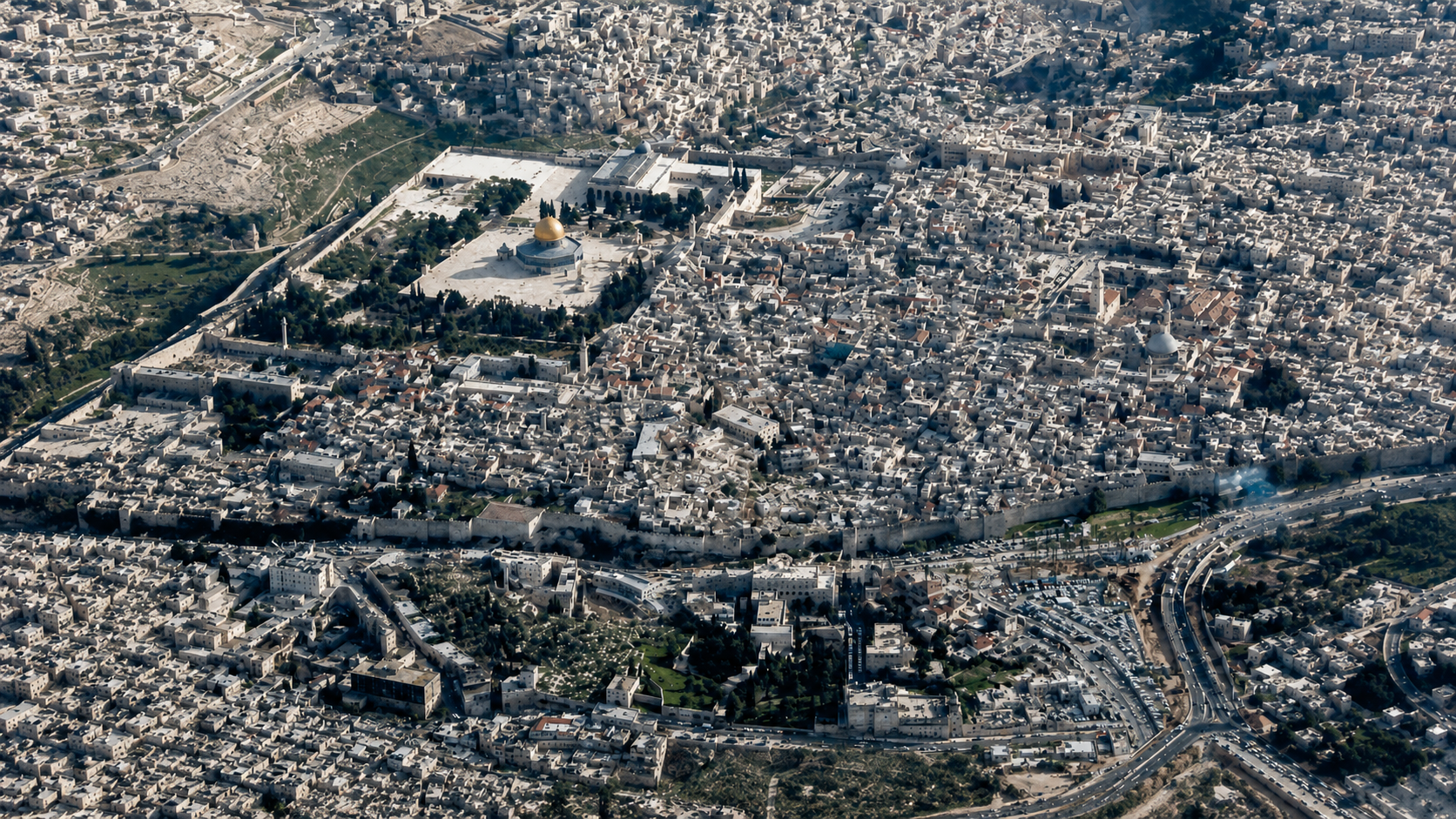
Aerial view of Jerusalem's Old City

Al-Quds and the Old City

Our city, guarded by its people simply by staying. Here are its walls, gates, quarters and landmarks what is being done to it today, and what we do alongside its people.

The Old City0.71% of the cityOf Jerusalem's total area of 125.156 km² · about 750 m above sea level
The Wall3,662 mBuilt by Suleiman the Magnificent over the ruins of the Roman wall · 11.6–12.2 m high
The Gates11 GatesSeven Open, Four Closed
World HeritageSince 1981The Old City and its walls inscribed on the UNESCO list

Our Old City

An area of less than one square kilometre inside a stone wall, home to Al-Aqsa Mosque, our ancient markets, and our quarters that have carried their people's names for centuries. To live here is not just to inhabit a home it is to guard a place.

The wall standing today was built by Sultan Suleiman the Magnificent Between 1535 and 1542. It runs about 4.3 kilometres, stands ten to fifteen metres high, and carries thirty-five towers most of them along the northern wall, the most exposed to attack.

Its Newest Gate is New Gate, opened in 1887 under Sultan Abdulhamid II to ease entry for the city's people and the neighbouring villages. It was closed in 1948 and later reopened.

Staying is the StruggleEvery Jerusalemite home restored, every family that stays within the walls, means the city still belongs to its people. Emptying the Old City of its residents is the aim; staying is the answer.
North: Damascus Gate, Herod's Gate and the New Gate.West: Jaffa Gate, the Citadel of Jerusalem, and Jaffa Gate market.South: Zion Gate, and the Moroccans' Gate under occupation control.East: The Gate of the Tribes, and the closed Gate of Mercy overlooking the cemetery.
A view from Jerusalem's Old City
Muslim QuarterChristian QuarterArmenian QuarterJewish Quarter(formerly Harat al-Sharaf and the Moroccan Quarter)Al-Aqsa MosqueChurch of the Holy SepulchreKhan Al-Zeit MarketDamascus GateHerod's GateNew GateLions' GateGate of Mercy (closed)Jaffa GateZion GateMoors' GateNorth WallEastWestSouth Wall

Map of the Old City

The four quarters, the gates and the landmarks within the walls. A drawing to introduce the locations, not a surveyed plan.

Open GatesMoroccans' Gate under occupation controlClosed GateThe Al-Aqsa Mosque Compound

Our Four Quarters

An old division of the walled city its boundaries are connected alleys and markets, not barriers.

Muslim QuarterThe largest and most populous quarter, stretching from Damascus Gate to the gates of Al-Aqsa Mosque, home to Mamluk schools and the old markets.
Christian QuarterIn the north-west of the town, home to the Church of the Holy Sepulchre, monasteries and markets, and its Christian Jerusalemite residents.
Armenian QuarterThe smallest quarter, in the south-west around St. James Monastery, home to one of the city's oldest communities.
Sharaf QuarterSouth of the town; its residents were displaced after 1967 and the area rebuilt as the 'Jewish Quarter', while the adjacent Moroccan Quarter by the Western Wall was demolished.

The Gates of the Wall

Seven open gates through which the city's people and visitors pass, and the Golden Gate in the east, sealed for centuries. Each gate is a name on the tongues of Jerusalemites before it is a mark on a map.

See their locations on the map ←
Damascus GateNorth · OpenHerod's GateNorth · OpenThe New GateNorth-west · OpenJaffa GateWest · OpenZion GateSouth · OpenMoroccans' GateSouth · Under Occupation ControlGate of the TribesEast · OpenGate of MercyEast · Closed

Landmarks Within the Walls

Mosques, markets, schools and water fountains and a quarter erased from the map but not from memory.

Heart of the CityAl-Aqsa MosqueIt occupies the town's south-eastern corner, with its alleys and markets leading to it; its gates are the destination of worshippers every day.
The Northern EntranceDamascus Gate and Its StepsThe most famous and busiest of the wall's gates; its steps form a plaza where townspeople gather, and Khan al-Zeit Market begins here.
The MarketsAl-Qattanin and Khan Al-Zeit MarketsCovered markets from the Mamluk era connect Damascus Gate to Al-Aqsa Mosque, with shops passed down through Jerusalemite families.
MemoryThe Moroccan QuarterAn old Waqf quarter adjoining the Western Wall, demolished after the city's occupation in 1967 and its residents displaced, replaced by a plaza.
LearningThe Mamluk SchoolsSchools and hostels surrounding the mosque from the north and west, such as al-Ashrafiyya and al-Tankiziyya, many now homes for Jerusalemite families.
The WallThe Wall and the CitadelA stone wall with its towers surrounds the town, and by Jaffa Gate stands the Citadel of Jerusalem with its minaret known as David's Tower.

What is intended for our Old City

Pressure on the people of the Old City runs daily in administrative and legal forms before it ever comes as a bulldozer:

Settlement Inside the QuartersSettlement outposts planted among inhabited homes within the walls, under permanent guard that changes life for the neighbours.
Demolition and Eviction OrdersOwnership claims and eviction and demolition orders on the pretext of unlicensed construction, while obtaining a licence is nearly impossible.
Taxes and FinesAccumulated taxes on homes and shops burden families until some are forced to leave.
Restrictions on RestorationRestoration of old homes is banned or obstructed, so they deteriorate until leaving becomes the only option for their residents.
Choking the MarketsClosures, barriers and rerouted visitor paths cut off livelihoods for Old City merchants.
Rewriting the NarrativeSigns, tours and tourist routes tell the city through a single narrative, erasing its Islamic and Arab history.

Detailed figures and dates are verified with the competent bodies in Al-Quds before publication.

The City's Status

East Jerusalem home to the Old City and Al-Aqsa Mosque has been occupied territory under international law since 1967, and no change to its status has been internationally recognised. The Old City and its walls were inscribed on the UNESCO World Heritage list in 1981, then on the list of heritage in danger in 1982.

World HeritageThe Old City and its walls were inscribed on the UNESCO list in 1981.
Heritage in DangerAdded to the danger list in 1982 and has not been removed since.
Jerusalem AwqafManages the Islamic holy sites within the walls and oversees their restoration.

Our role alongside the people of Al-Quds

We work so the Jerusalemite stays in his home: restoration, relief, education, and settling what weighs on the shoulders.

All Al-Quds Projects

Keep a Jerusalemite in his home

Your gift reaches a specific home within the walls, and its implementation report reaches you.

Your Zakat reaches the people of Palestine

2.5%Zakat Due on Wealth

Every Friday, share the reward of a worshipper praying at Al-Aqsa

$15Seat
One
$750Bus
Full

Journey to Al-Aqsa
Buses Carrying Worshippers Every Friday

﴿فَإِذَا جَاءَ وَعْدُ أُولَاهُمَا بَعَثْنَا عَلَيْكُمْ عِبَادًا لَنَا أُولِي بَأْسٍ شَدِيدٍ﴾

So when the first of the two promises came, We sent against you servants of Ours of great might, and they probed into the homes, and it was a promise fulfilled.

Translation of the meanings of the Qur'an King Fahd Complex for the Printing of the Holy Qur'an
Raising a qur'anic generation to protect Al-Quds and Al-Aqsa

The ‘Ibādan Lanā Project
Raising a qur'anic generation to protect Al-Quds and Al-Aqsa