﴿سُبْحَانَ الَّذِي أَسْرَىٰ بِعَبْدِهِ لَيْلًا مِنَ الْمَسْجِدِ الْحَرَامِ إِلَى الْمَسْجِدِ الْأَقْصَى الَّذِي بَارَكْنَا حَوْلَهُ﴾

Exalted is He who took His Servant by night from al-Masjid al-Haram to al-Masjid al-Aqsa, whose surroundings We have blessed, to show him of Our signs. Indeed, He is the Hearing, the Seeing.

Translation of the meanings of the Qur'an King Fahd Complex for the Printing of the Holy Qur'an
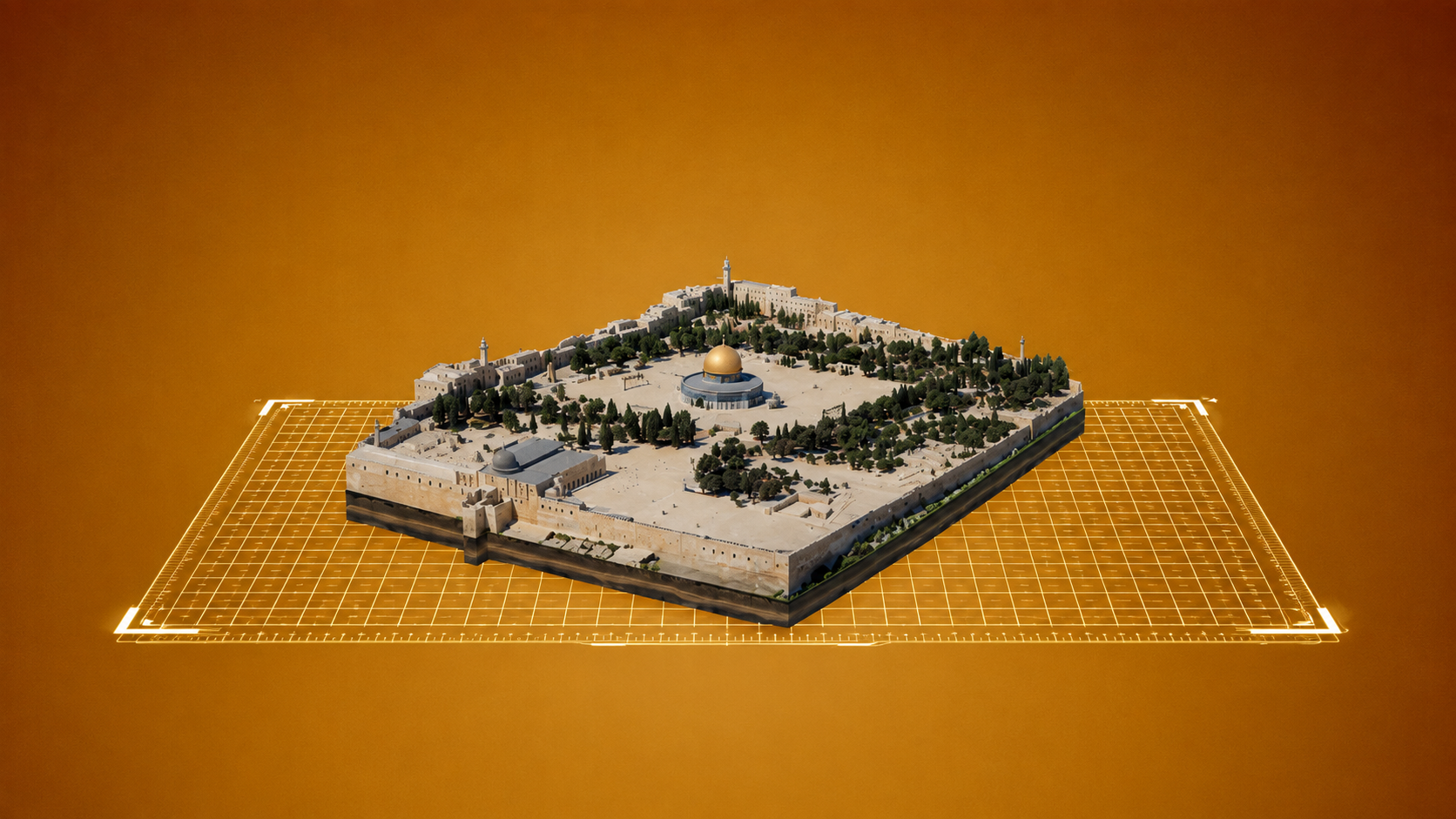
A model of the blessed Al-Aqsa Mosque within its walls

The Blessed Al-Aqsa Mosque

Our mosque, around which God placed His blessing — the first of the two qiblahs and the site of our Prophet's Night Journey. Here are its boundaries, its landmarks, and what is happening to it today.

Area144 Dunams and 100 m²One sixth of the Old City's area · Al-Quds Waqf Administration
Dimensions491 × 462 mWest and east, with 310 m to the north and 281 m to the south
RankThe Third MosqueTo which journeys are made, and the first of the two qiblahs for sixteen months
LandmarksSome 200 MonumentsOf which the official guide documents 136

What is Al-Aqsa Mosque?

Al-Aqsa is not a single building. It is everything the wall encloses in the south-eastern corner of our Old City some 144 dunams. Every span inside that wall is mosque.

The golden dome you see in photographs is The Dome of the Rock At the centre of the courtyard, and the lead-domed building to the south is The Qibli Mosque. Both are part of it, and neither may be called "Al-Aqsa" to the exclusion of the rest.
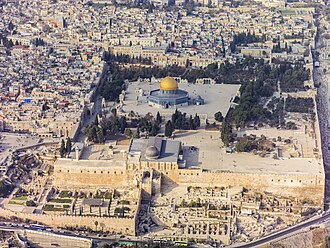
Beware This ConfusionConfining the name "Al-Aqsa" to the Dome of the Rock alone, or to the Qibli Mosque alone, shrinks its boundaries in people's minds. Al-Aqsa is the whole sanctuary: its wall, its courtyards, its prayer halls and its domes.
Aerial view of Al-Aqsa Mosque within its wall
North and west: Arcades and gates opening onto our quarters in the Old City.South: The Qibli Mosque, the Marwani Mosque, then the southern wall.East: The eastern wall overlooking the Kidron Valley and the Bab al-Rahma cemetery.At the centre: The raised Sahra courtyard, crowned by the Dome of the Rock.
Dome of the Rock CourtDome of the RockDome of the ChainPrayer HallAl-QibliOld AqsaPrayer HallAl-MarwaniSabil QaytbayAl-Kas FountainGhawanima MinaretBab Al-Asbat MinaretBab Al-Silsila MinaretFakhriyya MinaretBab Al-GhawanimaBab FaisalBab HittaBab Al-AsbatBab Al-NazirBab Al-HadidBab Al-QattaninBab Al-MatharaBab Al-SilsilaBab Al-MagharibaBab Al-Rahma (Closed)Southern Gates (Closed)Northern WallSouthern Wall · Qibla DirectionWestern WallEastern Wall

Map of the mosque and its landmarks

Locations of the landmarks and gates within the wall. A drawing to introduce the sites, not a surveyed plan.

Gates Open to WorshippersBab al-Maghariba under occupation controlSealed GatesThe Four MinaretsPrayer areas below courtyard level

Why it holds this standing with us

Its standing is established in our Lord's Book and our Prophet's Sunnah, and upon it rests the attachment Muslims from every land feel towards it.

Mentioned in the Holy Quran﴿سُبْحَانَ الَّذِي أَسْرَىٰ بِعَبْدِهِ لَيْلًا مِنَ الْمَسْجِدِ الْحَرَامِ إِلَى الْمَسْجِدِ الْأَقْصَى الَّذِي بَارَكْنَا حَوْلَهُ﴾Exalted is He who took His Servant by night from al-Masjid al-Haram to al-Masjid al-Aqsa, whose surroundings We have blessed, to show him of Our signs. Indeed, He is the Hearing, the Seeing.Surah Al-Isra: 1
The first of the two qiblasWe prayed facing it for about sixteen months before the qibla was changed to the Sacred Mosque.Established in the Sira
The second mosque placed on earthThe Prophet ﷺ was asked which mosque was built first on earth, and he said: the Sacred Mosque, then Al-Aqsa Mosque.Agreed Upon (Bukhari & Muslim)
The third of the mosques to which journeys are madeHe ﷺ said: "Journeys are made only to three mosques: the Sacred Mosque, this mosque of mine, and Al-Aqsa Mosque."Agreed Upon (Bukhari & Muslim)
The Night Journey and Ascension of the Prophet ﷺFrom it the ascension to the heavens took place, and there the Prophet ﷺ led the prophets in prayer.The Night Journey and Ascension
The multiplied reward of prayer thereHadiths mention that prayer there carries multiplied reward compared to other mosques.Narrated in the Sunan
The minbar whose name we bear

The Minbar of Saladin

The minbar of Al-Aqsa Mosque is among the rarest works ever crafted by human hands, and the most famous pulpit in history not only for its bond with the mosque, but for the story of liberation in the time of Salah al-Din al-Ayyubi. For some eight hundred years it stood as a symbol of victory and dignity, from the day it was set in place until it was burned in 1969.

Sultan Nur Al-Din Mahmud Zangi Ordered the finest craftsmen of Aleppo in 563 AH to build it in Damascus twenty years before the liberation so it would be placed in Al-Aqsa once the city was recovered. Nur al-Din died before seeing it in place, and after him came Salah Al-Din Yusuf Who liberated Bayt al-Maqdis on Friday 27 Rajab 583 AH and ordered the minbar brought and installed in the Qibli mosque.

It Was Built in the Interlocking (Tashiq)Style: ornamental wooden pieces holding one another without a single nail or drop of glue, of wood inlaid with ivory and ebony, bearing Qur'anic and historical inscriptions among them the verse “Indeed, Allah commands justice and excellence” to the preacher's right as he ascends, Nur al-Din's name to his left, and the names of its makers on its door.

12,000Interlocked Pieces Formed the Minbar
6 mIts height, with a four-meter base and a one-meter-wide stair
563 AHMade in Damascus by order of Nur al-Din Zangi
1969 CEThe minbar and mosque were burned on 21 August
Witness to the ArsonDr. Ikrima Sabri— preacher of Al-Aqsa Mosque and Custodian of the Minbar at Minbar Al Aqsa International Association, who examined the fire himself says the perpetrators were more than one person acting under official cover: the fire broke out in several spots at once, using highly flammable materials unavailable to the public, and the primary target was the minbar, the symbol of the city's liberation. They came at seven in the morning when few people were present; the people of Al-Quds men, women, elders and children rushed to form lines passing earth and water, until fire engines arrived from Hebron, Bethlehem and Ramallah after the occupation authorities had obstructed their way.

The Mosque's Landmarks

Within the wall are more than two hundred landmarks prayer halls, domes, arcades, fountains, benches and wells. These are the most prominent.

Center of the MosqueThe Dome of the RockIt stands at the center of the raised Rock courtyard above the Noble Rock an octagonal building topped with a golden dome, its walls faced with blue tiles renewed in the Ottoman era. It is among the oldest Islamic buildings still standing today.Built:Under Abd al-Malik ibn Marwan, completed 72 AHLocation:The Rock courtyard, at the centre of the mosque grounds
South of the MosqueAl-Qibli Prayer HallThe large lead-domed building at the southernmost, qibla-facing end of the mosque the main hall for Friday and congregational prayer. Built in the Umayyad era, and rebuilt in succession by the Umayyads, Abbasids, Fatimids, Ayyubids, Mamluks and Ottomans.Area:About 4,000 m² · 80 × 55 m, with 11 doorsNotable feature:The mihrab, the minbar and Maqam al-Arba'in
South-eastAl-Marwani Prayer HallA vast vaulted hall on massive columns beneath the south-eastern corner of the mosque, part of the levelling that raised the mosque courtyard. It was cleared and prepared for prayer in the 1990s, becoming one of its largest halls.Location:Below the level of the south-eastern courtyardCharacter:Massive Stone Arcades and Arches
Beneath Al-QibliThe Old Aqsa MosqueA vaulted passage and prayer hall extending beneath Al-Qibli, ending at the Double Gate in the southern wall once an entrance for worshippers before the southern gates were closed.Connects to:Leads to the closed Double GateStatus:Opened for prayer during crowded times
East of the DomeThe Dome of the ChainA small open dome resting on marble columns directly east of the Dome of the Rock, among the oldest domes still standing in the mosque, used as a prayer spot and a place for sitting and teaching.Style:An open structure on columns, without wallsLocation:Adjoining the Dome of the Rock to the east
The Mosque's WallsThe Four MinaretsThe mosque has four standing minarets: the Bab al-Asbat minaret to the north, the Bab al-Ghawanima minaret to the north-west, the Bab al-Silsila minaret to the west, and the Fakhriyya minaret to the south-west. Most were built in the Ayyubid and Mamluk eras.Number:Four minarets on the northern and western wallsArchitecture:Ayyubid and Mamluk
The CourtyardsThe Arcades and Learning PlatformsStone arcades and vaults surround the Rock courtyard, and learning platforms are spread across the grounds, where teaching and memorisation circles have been held for centuries and are still used for lessons and retreat.Use:Study and memorisation circles, and gatherings of the murabitunExtent:Around the Rock courtyard and across the grounds
WaterThe Wells and FountainsThe mosque has thirty-seven wells collecting rainwater, and fountains for drinking and ablution, the most famous being the Mamluk-era Qaytbay Fountain west of the Rock courtyard, alongside the Cup Ablution Place between Al-Qibli and the Rock courtyard.Wells:37 wells · managed by the Jerusalem Waqf DepartmentMost notable:Qaytbay Fountain · the Cup Ablution Place
The SurroundingsThe Schools and ZawiyasAyyubid and Mamluk-era schools, hospices and zawiyas surround the mosque to the north and west, built to serve students and residents; many today are homes for Jerusalemite families adjoining the mosque walls.Era:Ayyubid and MamlukExamples:Al-Ashrafiyya · Al-Tankiziyya · Al-Umariyya schools

The Mosque's Gates and Walls

The mosque has gates in its northern and western walls; ten are open today, while the rest have been closed for centuries or were sealed later. The southern and eastern walls are entirely closed.

The Maghrebi Gate is the only entrance controlled by the occupation, and the incursions come through it, while worshippers enter by the remaining gates.

Gate of the Tribes (Bab al-Asbat)North · OpenBab HittaNorth · OpenBab FaisalNorth · OpenBab Al-GhawanimaNorth-west · OpenBab Al-NazirWest · OpenIron Gate (Bab Al-Hadid)West · OpenCotton Merchants' Gate (Bab Al-Qattanin)West · OpenBab Al-MatharaWest · OpenChain Gate (Bab Al-Silsila)West · OpenMoroccans' Gate (Bab Al-Maghariba)West · Under Occupation ControlGate of Mercy and Repentance (Bab al-Rahma)East · ClosedThe Triple, Double and Single GatesSouth · ClosedFunerals' Gate (Bab Al-Jana'iz)North · Closed

Milestones our mosque has passed through

Before IslamThe Second Mosque on EarthBuilt forty years after the Sacred Mosque, its structure maintained successively by the prophets, peace be upon them.
15 AH / 637 CEThe Umarid ConquestUmar ibn al-Khattab entered Jerusalem peacefully and gave its people the Umarid Covenant, securing them and their churches.
72 AH / 691 CEConstruction of the Dome of the RockThe Dome of the Rock was completed under Abd al-Malik ibn Marwan, and Al-Qibli Prayer Hall was later built in the Umayyad era.
492 AH / 1099 CEThe Crusader OccupationJerusalem was occupied and the mosque converted into a church and stable, lasting about ninety years.
583 AH / 1187 CEThe Liberation by SaladinSaladin liberated Jerusalem after the Battle of Hattin, restored the mosque, and installed the minbar of Nur al-Din.
947 AH / 1541 CEThe Ottoman EraJerusalem's wall was renewed under Sultan Suleiman the Magnificent, and the Dome of the Rock was faced with tiles.
1967 CEThe Occupation of East JerusalemEast Jerusalem, containing Al-Aqsa Mosque, was occupied, and the Maghariba Quarter adjoining the Western Wall was demolished.
1969 CEThe Mosque FireFire was set in Al-Qibli Prayer Hall, consuming the historic minbar of Nur al-Din Zangi, later replaced.

What we live at Al-Aqsa today

Since the occupation of eastern Jerusalem in 1967 we have faced measures that never stop. The most notable are:

Repeated IncursionsSettler groups enter via Bab al-Maghariba under armed protection and perform rituals in our courtyards.
Temporal and Spatial DivisionAttempts to allocate times and spaces inside the mosque to non-Muslims at the expense of worshippers.
Excavations Beneath the MosqueTunnels and excavations around and beneath it threaten its foundations and structure.
Entry Restrictions and ExpulsionsBarring categories of people from access, and expulsion orders against murabitun, staff and guards.
Restricting Restoration and MaintenanceObstruction of restoration work inside it, leaving damage in the buildings and arcades.
Emptying the surroundings of their peopleTaxes and demolition and eviction orders against Old City residents to displace them from the mosque.

Detailed figures and dates are verified with the competent bodies in Al-Quds before publication.

Who Administers the Mosque

Al-Aqsa Mosque is administered by the Jerusalem Awqaf and Al-Aqsa Mosque Affairs Department, the body responsible for restoration, maintenance, study circles and the guards, working under the Hashemite custodianship of the holy sites in Al-Quds. Everything published on this page about the mosque's area, landmarks and wells is based on its data and official guide.

The Al-Quds Waqf DepartmentThe official body that administers the mosque and oversees its restoration, upkeep and study circles.
The Mosque GuardsWaqf staff who regulate entry and protect the monuments within the walls.
The Hashemite CustodianshipThe historic framework of care for the Islamic and Christian holy sites in Al-Quds.

Our Role in Serving Al-Aqsa

With our teams in Al-Quds we strengthen those who hold their ground and serve the worshippers — through defined projects, each with its own report.

All Al-Quds Projects
Al-Aqsa Mosque
Al-Aqsa Mosque
Al-Aqsa Mosque
Al-Aqsa Mosque
Let us be a minbar for Al-QudsYour Waqf or gift reaches a specific Jerusalem project, and its implementation report reaches you.
$300
Donate Now

إنجازاتنا في المسجد الأقصى

Let us be a minbar for Al-Quds

Your Waqf or gift reaches a specific Jerusalem project, and its implementation report reaches you.

Your Zakat reaches the people of Palestine

2.5%Zakat Due on Wealth

Every Friday, share the reward of a worshipper praying at Al-Aqsa

$15Seat One$750Bus Full

Journey to Al-Aqsa

Buses Carrying Worshippers Every Friday

So when the first of the two promises came, We sent against you servants of Ours of great might, and they probed into the homes, and it was a promise fulfilled. — Surah Al-Isra: 5

The ‘Ibādan Lanā Project

Raising a qur'anic generation to protect Al-Quds and Al-Aqsa