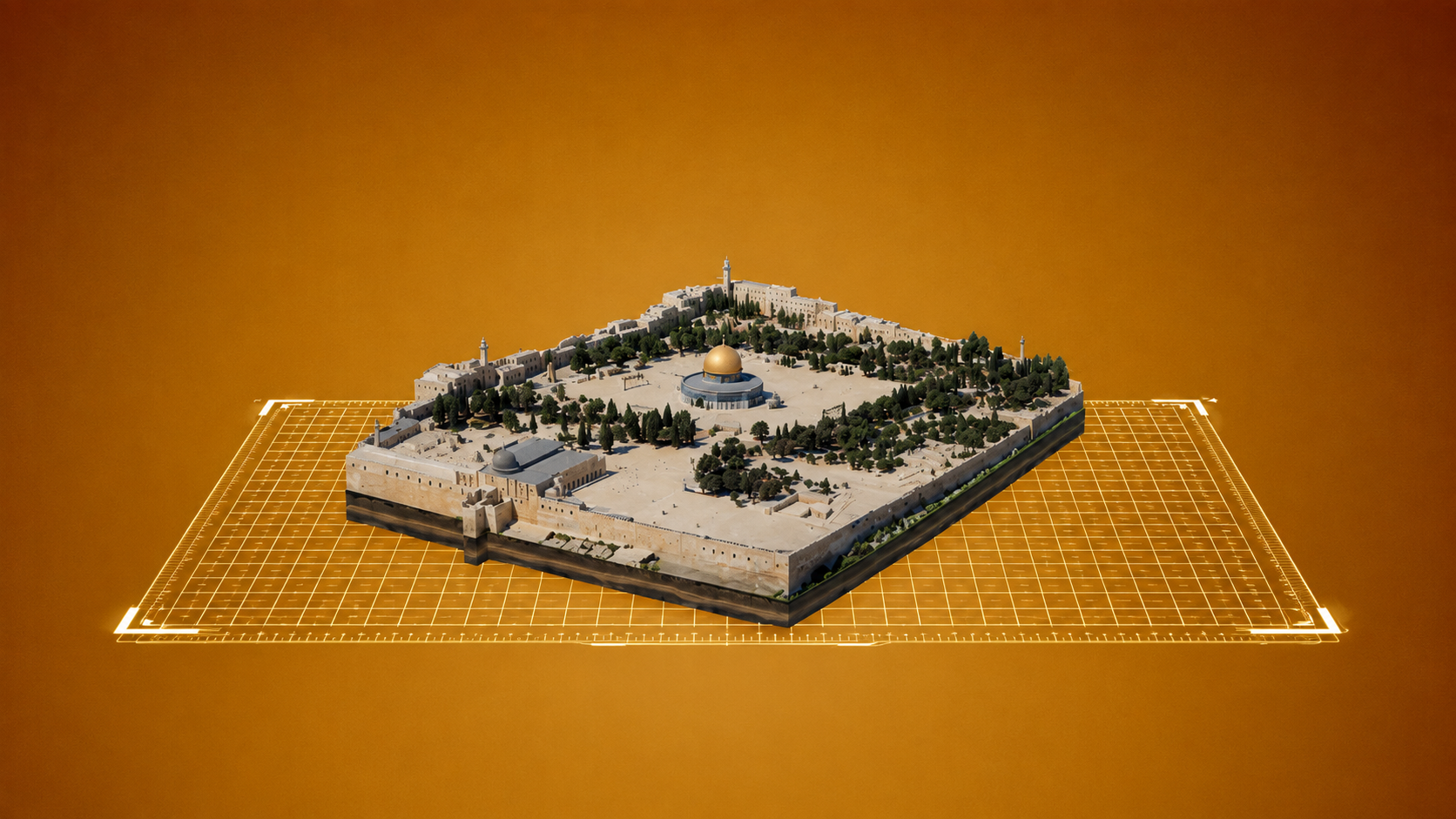
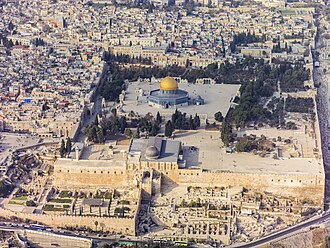
Center of the mosqueThe Dome of the RockIt stands at the center of the raised Rock courtyard above the Noble Rock an octagonal building topped with a golden dome, its walls faced with blue tiles renewed in the Ottoman era. It is among the oldest Islamic buildings still standing today.Built:Under Abd al-Malik ibn Marwan, completed 72 AHLocation:The Rock courtyard, at the centre of the mosque grounds
South of the mosqueAl-Qibli Prayer HallThe large lead-domed building at the southernmost, qibla-facing end of the mosque the main hall for Friday and congregational prayer. Built in the Umayyad era, and rebuilt in succession by the Umayyads, Abbasids, Fatimids, Ayyubids, Mamluks and Ottomans.Area:About 4,000 m² · 80 × 55 m, with 11 doorsNotable feature:The mihrab, the minbar and Maqam al-Arba'in
South-eastAl-Marwani Prayer HallA vast vaulted hall on massive columns beneath the south-eastern corner of the mosque, part of the levelling that raised the mosque courtyard. It was cleared and prepared for prayer in the 1990s, becoming one of its largest halls.Location:Below the level of the south-eastern courtyardCharacter:Massive stone arcades and arches
Beneath Al-QibliThe Old Aqsa MosqueA vaulted passage and prayer hall extending beneath Al-Qibli, ending at the Double Gate in the southern wall once an entrance for worshippers before the southern gates were closed.Connects to:Leads to the closed Double GateStatus:Opened for prayer during crowded times
East of the DomeThe Dome of the ChainA small open dome resting on marble columns directly east of the Dome of the Rock, among the oldest domes still standing in the mosque, used as a prayer spot and a place for sitting and teaching.Style:An open structure on columns, without wallsLocation:Adjoining the Dome of the Rock to the east
The mosque's wallsThe Four MinaretsThe mosque has four standing minarets: the Bab al-Asbat minaret to the north, the Bab al-Ghawanima minaret to the north-west, the Bab al-Silsila minaret to the west, and the Fakhriyya minaret to the south-west. Most were built in the Ayyubid and Mamluk eras.Number:Four minarets on the northern and western wallsArchitecture:Ayyubid and Mamluk
The courtyardsThe Arcades and Learning PlatformsStone arcades and vaults surround the Rock courtyard, and learning platforms are spread across the grounds, where teaching and memorisation circles have been held for centuries and are still used for lessons and retreat.Use:Study and memorisation circles, and gatherings of the murabitunExtent:Around the Rock courtyard and across the grounds
WaterThe Wells and FountainsThe mosque has thirty-seven wells collecting rainwater, and fountains for drinking and ablution, the most famous being the Mamluk-era Qaytbay Fountain west of the Rock courtyard, alongside the Cup Ablution Place between Al-Qibli and the Rock courtyard.Wells:37 wells · managed by the Jerusalem Waqf DepartmentMost notable:Qaytbay Fountain · the Cup Ablution Place
The surroundingsThe Schools and ZawiyasAyyubid and Mamluk-era schools, hospices and zawiyas surround the mosque to the north and west, built to serve students and residents; many today are homes for Jerusalemite families adjoining the mosque walls.Era:Ayyubid and MamlukExamples:Al-Ashrafiyya · Al-Tankiziyya · Al-Umariyya schools